
What Tests Do You Need Before Varicose Vein Treatment?
What Tests Do You Need Before Varicose Vein Treatment?
Seeing enlarged veins on your legs does not always tell you what is happening underneath the skin. Before choosing a treatment, a specialist needs to know which veins are affected and whether abnormal blood flow is contributing to the problem. That is where ultrasound can be especially useful. It provides information that a physical examination alone cannot always reveal and can help guide a more appropriate treatment decision.
🩻 Tests for Varicose Veins: What May Be Needed?
Not every patient needs a long list of tests before treatment. The evaluation usually starts with your symptoms, medical history, and a physical examination. When there is a concern about how blood is moving through the leg veins, a duplex ultrasound may be recommended. This noninvasive test can examine the veins while also assessing blood flow. The purpose is not simply to confirm that visible veins are present. It is to determine whether there is an underlying problem that should influence your treatment.
🔍 What Does an Ultrasound for Varicose Veins Show?
An ultrasound for varicose veins can provide information about both the structure of the veins and how blood moves through them.
The examination can help identify:
The location and condition of affected veins
How blood is moving through the vessels
Whether the valves are working properly
Areas where blood is flowing backward
Veins that may be contributing to your symptoms
Backward blood flow is known as venous reflux. It can occur when the valves inside the veins do not close effectively, allowing blood to move back toward the legs instead of efficiently returning to the heart. Identifying reflux can be particularly important when treatment is being considered.
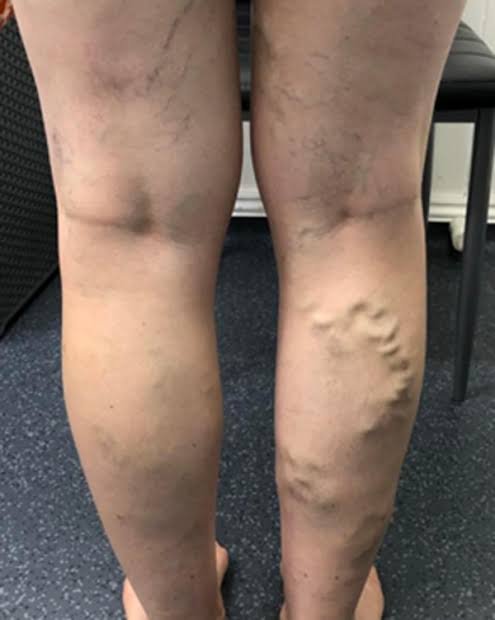
Varicose veins visible on both legs.
🩺 What Happens During a Varicose Vein Ultrasound?
A varicose vein ultrasound is generally straightforward and does not involve needles or incisions. You will typically lie down while a trained professional applies gel to the skin of your leg. A handheld ultrasound device is then moved over different areas to create images and assess blood flow. You may be asked to change positions or perform simple movements during the examination. This can help the specialist observe how blood behaves under different conditions. The test is generally painless, although you may feel mild pressure from the ultrasound device as different areas are examined.
🗺️ Why Vein Mapping Can Matter for Treatment
When a procedure is being considered, the ultrasound findings can help create a clearer picture of the veins that may need attention. This process is sometimes referred to as vein mapping. It helps identify the location and pathway of relevant veins and can provide useful information for planning treatment. Rather than treating only the most visible vessel, the specialist can use the findings to understand which veins may be contributing to the problem.
🎯 How Ultrasound Helps With Treatment Planning
The purpose of testing is ultimately to help determine which treatment, if any, makes sense for you. If a larger vein is affected by reflux, a specialist may consider a procedure such as ablation to close the abnormal vessel. Smaller surface veins may be better suited to injections such as sclerotherapy. In some cases, more than one approach may be appropriate. The important point is that treatment should be based on the underlying vein problem rather than appearance alone.
💉 Does Everyone Need the Same Testing?
No. Your symptoms and examination findings help determine what evaluation is appropriate. Some visible veins may not require extensive investigation, particularly when they are small and not associated with symptoms. When there is swelling, aching, heaviness, skin changes, or concern about abnormal blood flow, imaging can provide important information. Your specialist can explain which testing is recommended and why it may be useful before moving forward with treatment.
🩻 What Happens After the Ultrasound?
Once the examination is complete, the findings can be reviewed alongside your symptoms and physical examination. If abnormal blood flow is identified, your specialist can explain what it means and whether it is contributing to your visible veins or other symptoms. From there, you can discuss appropriate treatment options and what to expect from each. If the ultrasound does not show a significant underlying problem, treatment decisions may look different. In some cases, monitoring or conservative care may be more appropriate than a procedure.
❓ Frequently Asked Questions
-
The evaluation typically begins with your medical history and physical examination. When the function of the leg veins needs to be assessed, a duplex ultrasound may be used to examine the veins and blood flow.
-
Not every patient requires the same testing. However, ultrasound is often useful when a specialist needs to determine whether abnormal blood flow or reflux is contributing to the visible veins and which vessels may need treatment.
-
It can show the structure of the veins and how blood is moving through them. It can also identify abnormal backward flow that may indicate a problem with the valves.
-
Ultrasound findings can provide important information for treatment planning, but the decision also considers your symptoms, physical examination, and overall vein health. Together, these findings help the specialist determine which approach may be appropriate.
📍 Start With the Right Evaluation
Choosing a vein treatment before understanding what is happening beneath the skin can leave the underlying problem unaddressed. The right evaluation gives you a clearer picture of which veins are involved and what options may be appropriate.
Inland Vein & Wound Specialists can assess your symptoms and use appropriate imaging to support personalized treatment planning.
Schedule an evaluation today to find out what your veins need and which treatment options may be right for you.
