
Can Treating Your Veins Relieve Leg Swelling?
Can Treating Your Veins Relieve Leg Swelling?
Swollen legs are easy to blame on a long day, hot weather, or too much time on your feet. But when the swelling keeps returning, especially alongside heaviness, aching, or visible veins, your circulation may be playing a role. When the veins cannot move blood upward efficiently, pressure can build in the lower legs. Treating the underlying problem may help reduce swelling in some patients, but first it is important to understand what is causing it.
🩺 Can Vein Treatment Reduce Leg Swelling?
Yes, can vein treatment reduce leg swelling? It can when the swelling is being caused or worsened by an underlying venous problem. When vein valves do not close properly, blood can move backward and collect in the lower legs instead of flowing efficiently toward the heart. This blood pooling increases pressure inside the veins and can cause fluid to move into surrounding tissues. The resulting edema may appear as puffiness around the ankles, lower legs, or feet and may become more noticeable later in the day.
However, treating the veins will not necessarily resolve swelling caused by another condition. That is why identifying the source of the swelling is an important part of the evaluation.
🔄 How Do Vein Problems Cause Swelling?
Healthy leg veins rely on small valves to help keep blood moving in the right direction. When these valves become ineffective, blood can flow backward, creating venous reflux. Over time, the increased pressure can make the veins more prominent and contribute to symptoms such as aching, heaviness, itching, and swelling. This pattern can occur with venous insufficiency, including chronic forms of the condition that develop gradually. Swelling related to circulation may be worse after standing or sitting for long periods and may improve when the legs are elevated. These patterns can provide useful clues, but they do not confirm the cause on their own.
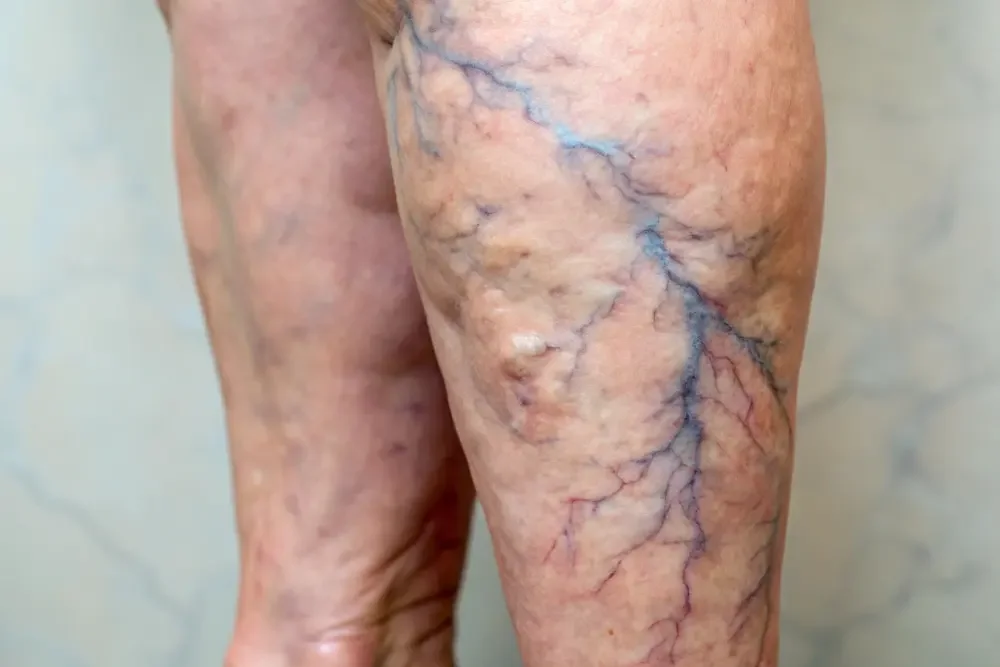
Close-up of severe, twisted, and bulging varicose veins with significant surface discoloration on a patient's lower limb
🦵 Varicose Veins and Leg Swelling Treatment
Varicose veins and leg swelling treatment
Visible varicose veins and swelling can occur together when the enlarged vessels are associated with abnormal blood flow. But the visible veins themselves are not necessarily the reason your legs are swollen. A provider may need to determine whether reflux is occurring in a deeper or larger vessel and whether that problem is contributing to your symptoms. If an underlying source is identified, treating it may improve circulation and reduce the pressure contributing to the swelling. The amount of improvement varies. Some patients notice meaningful symptom relief after treatment, while others may continue to have swelling if another condition is also contributing.
🩻 Why Is a Vein Ultrasound Useful?
A vein ultrasound can provide information that cannot be obtained by simply looking at the legs. Duplex ultrasound can show how blood is moving through the vessels and help identify reflux or other abnormalities. This can help determine whether the swelling is consistent with a venous problem and which vessels may be involved. The findings can then guide decisions about whether treatment is appropriate and which approach may be considered. Without this information, it can be difficult to know whether swelling should be addressed through treatment of a problematic vein or evaluated for another cause.
⚕️ Can Treating Reflux Improve Swelling?
When venous disease is contributing to swelling, addressing the refluxing vessel may improve the way blood circulates through the leg. For some patients, treatment may involve closing an abnormal vein using a procedure such as RFA. Once the targeted vessel is closed, blood can reroute through healthier veins. Other treatment options may be considered depending on the affected vessels and the findings from the evaluation. The purpose is not simply to make visible veins disappear. When treatment is appropriate, the goal is to address the underlying circulation problem that may be contributing to symptoms.
🧦 What About Compression?
Compression may help manage swelling by providing graduated pressure that supports blood movement through the legs. It can be recommended as part of conservative care or alongside other treatment, depending on the patient's condition. Compression does not correct every cause of swelling and may not be appropriate for everyone. Your healthcare provider can determine whether it is suitable based on your overall circulation and medical history.
🔎 Is All Leg Swelling Caused by Veins?
No. This is an important distinction. Swelling can have many causes, including heart or kidney conditions, certain medications, lymphatic problems, injuries, infections, and other medical conditions. Acute vascular problems can also cause sudden swelling and require prompt evaluation. Because of these possibilities, it is not safe to assume that recurring swelling is simply related to visible veins. A proper assessment can help determine whether the pattern fits a venous condition or whether another type of medical evaluation is needed.
🚨 When Does Leg Swelling Need Prompt Attention?
Sudden swelling in one leg, particularly when accompanied by pain, warmth, redness, or tenderness, should be evaluated promptly. Shortness of breath, chest pain, fainting, or other sudden concerning symptoms also require urgent medical attention. These symptoms can have causes that are different from chronic venous problems and should not be attributed to enlarged veins without an appropriate assessment. For swelling that is persistent, recurrent, unexplained, or gradually worsening, arranging a professional evaluation is also worthwhile.
🩺 When Should You Consider a Vein Evaluation?
If swelling repeatedly appears around your ankles or lower legs, especially alongside aching, heaviness, visible veins, itching, or skin changes, it may be worth discussing your symptoms with a specialist. An evaluation can include a physical examination and, when appropriate, ultrasound testing to determine whether chronic venous insufficiency or reflux is contributing to the problem. From there, your provider can explain whether conservative measures, treatment of an affected vessel, or further investigation is appropriate. The goal is to treat the cause when possible rather than assuming every swollen leg needs the same solution.
📍 Find Out What Is Behind Your Swelling
Persistent swelling deserves attention, but it does not automatically mean that you need a vein procedure. The first step is understanding why the swelling is happening and whether your veins are actually contributing to it. A vein specialist can review your symptoms, examine your legs, and use appropriate testing to look for problems with blood flow or valve function.
If an underlying vein circulation problem is identified, appropriate treatment may help improve blood flow and reduce related symptoms. If the swelling has another cause, your evaluation can help point you toward the appropriate next step. For patients in Rancho Cucamonga and surrounding communities, getting an evaluation from an experienced specialist can provide a clearer picture of what is causing the swelling and whether vein care is appropriate for you. Schedule an evaluation today to find out what may be causing your swelling and what options may help.
❓ Frequently Asked Questions
-
Venous insufficiency can contribute to swelling because blood can pool in the lower extremities when venous valves do not function properly.
-
If an underlying vein circulation problem is contributing to the swelling, treating the affected veins may help. However, swelling can have many causes and should be evaluated rather than automatically attributed to visible veins.
-
Persistent, recurrent, or unexplained swelling should be discussed with a healthcare professional, particularly when it is accompanied by pain, skin changes, or other symptoms.
