
Varicose Veins: Which Treatment Is Right for You?
Varicose Veins: Which Treatment Is Right for You?
You already know you have varicose veins. Now comes the harder question: What should you actually do about them? Radiofrequency ablation, laser treatment, sclerotherapy, and compression can all have a role, but they are designed for different situations. The right choice depends on what is causing your vein problems, which vessels are involved, and what your evaluation shows.
🩺 What Are the Main Varicose Vein Treatment Options?
When comparing varicose vein treatment options, it helps to understand that treatment is not simply about making visible veins disappear. If abnormal blood flow is contributing to your symptoms, the underlying problem may need to be addressed as well. Some treatments close larger veins that are allowing blood to flow backward. Others target smaller surface vessels. Conservative measures may also be appropriate when symptoms are mild or when a procedure is not currently necessary.
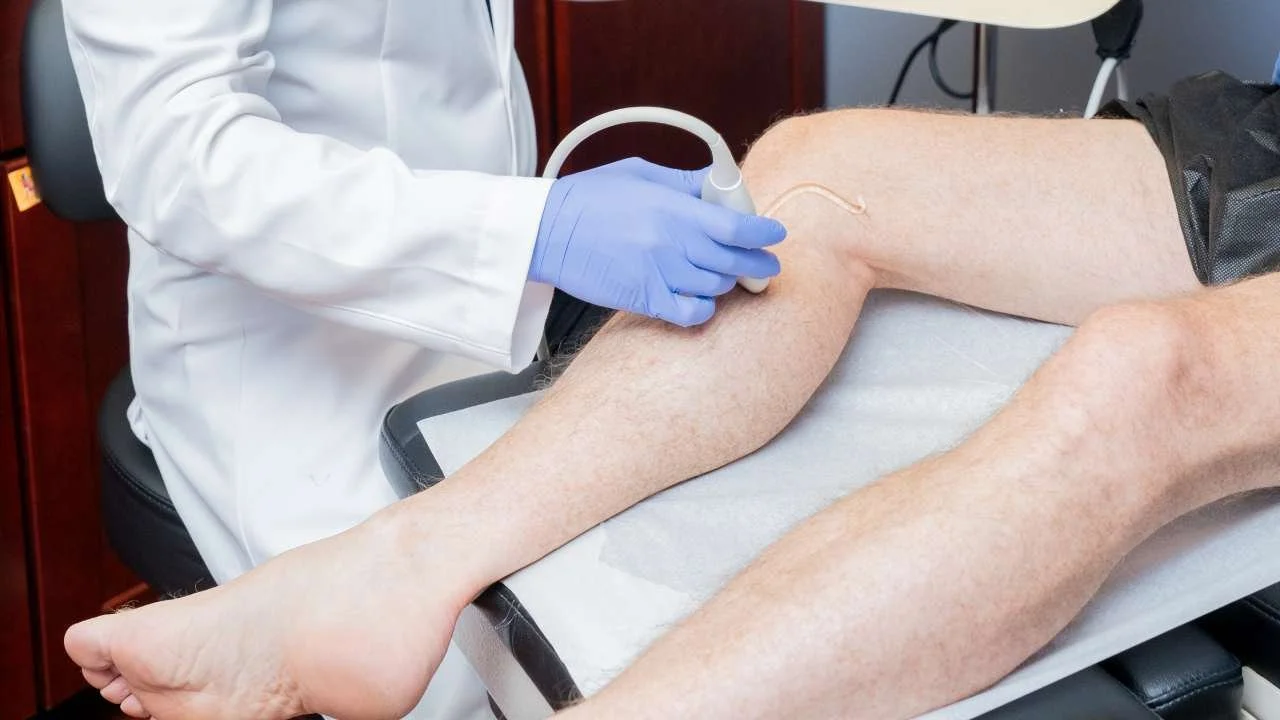
Doctor wearing blue gloves using an ultrasound probe to examine blood flow in a patient's leg
The main options include:
Radiofrequency ablation (RFA): Uses controlled heat to close an unhealthy vein associated with abnormal blood flow.
Endovenous laser ablation: Uses laser energy to close a targeted vein from inside the vessel.
Sclerotherapy: Uses an injected solution to treat selected smaller or surface veins.
Compression therapy: Uses graduated compression to support circulation and may help manage symptoms in appropriate patients.
The important point is that these options are not interchangeable. Your vein anatomy and diagnostic findings help determine which approach makes sense.
🔥 How Does Radiofrequency Ablation Work?
Radiofrequency ablation, often called RFA, is a minimally invasive procedure used to close a larger vein that is contributing to venous reflux. A thin catheter is placed into the targeted vessel, and radiofrequency energy delivers controlled heat to the vein wall. The treated vessel closes, allowing blood to reroute through healthier veins. RFA may be considered when ultrasound shows that a larger vein is not functioning properly and is contributing to symptoms or other findings. Because it is performed through a small access point rather than traditional open surgery, recovery is generally different from that associated with surgical vein removal. Whether RFA is appropriate depends on the location and size of the affected vessel, the degree of reflux, and your overall evaluation.
💡 What About Laser Ablation?
Endovenous laser treatment works on a similar principle but uses laser energy rather than radiofrequency energy. During the procedure, a thin fiber is guided into the targeted vein. Laser energy heats the vessel, causing it to close. As with RFA, the blood does not simply stop circulating; it can move through other healthy veins. Laser ablation may be suitable for certain patients with reflux affecting a larger vein. The choice between laser and radiofrequency treatment is not something patients need to decide based on the name of the technology alone. Your provider can consider your vein anatomy, ultrasound findings, symptoms, and treatment goals when determining whether either option is appropriate.
💉 When Is Sclerotherapy Used?
Sclerotherapy is an injectable treatment commonly used for smaller visible veins and selected branches that may not require catheter-based ablation. A provider injects a sclerosing solution into the targeted vessel. The solution irritates the inside of the vein, causing it to close. Over time, the treated vessel can become less visible as the body gradually processes it. Multiple treatment sessions may sometimes be needed, and temporary bruising, redness, or discoloration can occur. Sclerotherapy is therefore not simply a smaller version of ablation—it is suited to different types of vessels and clinical situations.
🧦 Can Compression Therapy Be Enough?
Compression therapy may help improve symptoms such as aching, heaviness, or swelling by supporting blood flow in the legs. It can be useful as part of conservative management, particularly when symptoms are mild, a procedure is not indicated, or a provider recommends it alongside other care. However, compression does not close an abnormal vein or correct every underlying cause of venous reflux. Whether it is appropriate for you depends on your overall circulation and medical situation. A specialist can explain whether compression is reasonable as a stand-alone approach or as part of a broader treatment plan.
🩻 Why Is a Vein Ultrasound Important Before Treatment?
Choosing a treatment based only on what is visible on the skin can miss what is happening underneath. A vein ultrasound, particularly a duplex ultrasound, can evaluate blood flow and identify venous reflux. It can help show which vessels are affected, how blood is moving through them, and whether an underlying problem is contributing to your symptoms. This information is especially important when deciding between treatments. A larger vein with significant reflux may call for a different approach than a small surface vessel. Without understanding the underlying anatomy, it can be difficult to determine whether ablation, injection treatment, conservative care, or another option is appropriate.
🔎 What Determines the Right Treatment?
Best treatment for varicose veins
There is no single treatment that is best for everyone. The right option depends on which veins are affected, whether venous reflux is present, the symptoms you are experiencing, and what your ultrasound shows. Larger veins with abnormal blood flow may require a different approach than smaller surface vessels, while symptoms such as pain, swelling, heaviness, or skin changes may also influence the recommendation. Your treatment goals matter as well, since someone seeking relief from discomfort may have different priorities from someone mainly concerned about visible veins. A thorough evaluation brings these factors together, helping your provider recommend an approach based on your specific vein condition rather than a one-size-fits-all treatment.
📍 Choosing Rancho Cucamonga Vein Treatment
If you are considering Rancho Cucamonga vein treatment, start with an evaluation rather than trying to choose a procedure on your own. An experienced vein specialist can review your symptoms, examine your legs, and use appropriate ultrasound imaging to determine what is happening beneath the surface. From there, you can discuss whether RFA, laser ablation, sclerotherapy, compression, or another approach is appropriate for your specific condition. The goal is not to find the procedure with the most impressive name. It is to identify the treatment that addresses your particular vein problem safely and appropriately.
❓ Frequently Asked Questions
-
There is no single treatment that is best for every patient. The appropriate option depends on the veins involved, the presence of venous reflux, symptoms, and findings from a clinical evaluation and ultrasound.
-
Many varicose veins can be treated with minimally invasive procedures such as radiofrequency or laser ablation. The appropriate treatment depends on the underlying vein problem.
-
Description text goes here
