
Can You Get Rid of Varicose Veins Without Surgery?
The idea of treating varicose veins often brings to mind incisions, hospital stays, and a long recovery. But modern vein care does not always require traditional surgery. Several procedures can treat problematic veins through small access points rather than removing them through surgical incisions. The key is understanding what is causing the veins to become enlarged in the first place. Once the underlying problem is identified, a provider can determine whether a less invasive approach is appropriate.
🩺 Can You Get Varicose Vein Treatment Without Surgery?
Yes, many patients can receive varicose vein treatment without surgery in the traditional sense. Instead of physically removing an affected vessel through surgical incisions, modern procedures can close or treat the problematic vein from inside or through targeted injections. These approaches are often performed in an outpatient setting and may use local anesthesia or numbing medication rather than general anesthesia. The exact technique depends on the size and location of the affected veins, whether abnormal blood flow is present, and what your evaluation shows.
“Non-surgical” does not mean that no medical procedure is involved. It generally refers to treatment that avoids traditional open surgery and uses smaller access points or injections instead.
🔥 How Does Radiofrequency Ablation Work?
Radiofrequency ablation uses controlled heat to close a vein that is contributing to abnormal blood flow. A thin catheter is guided into the targeted vessel, and radiofrequency energy is delivered to the vein wall. Once the vessel closes, blood can reroute through healthier veins. This approach may be considered when venous reflux is identified in a suitable larger vein. Because the procedure is performed through a small access point rather than removing the vessel through a surgical incision, it is considered minimally invasive. The vein remains in the body but is no longer carrying the abnormal flow that made it a treatment target.
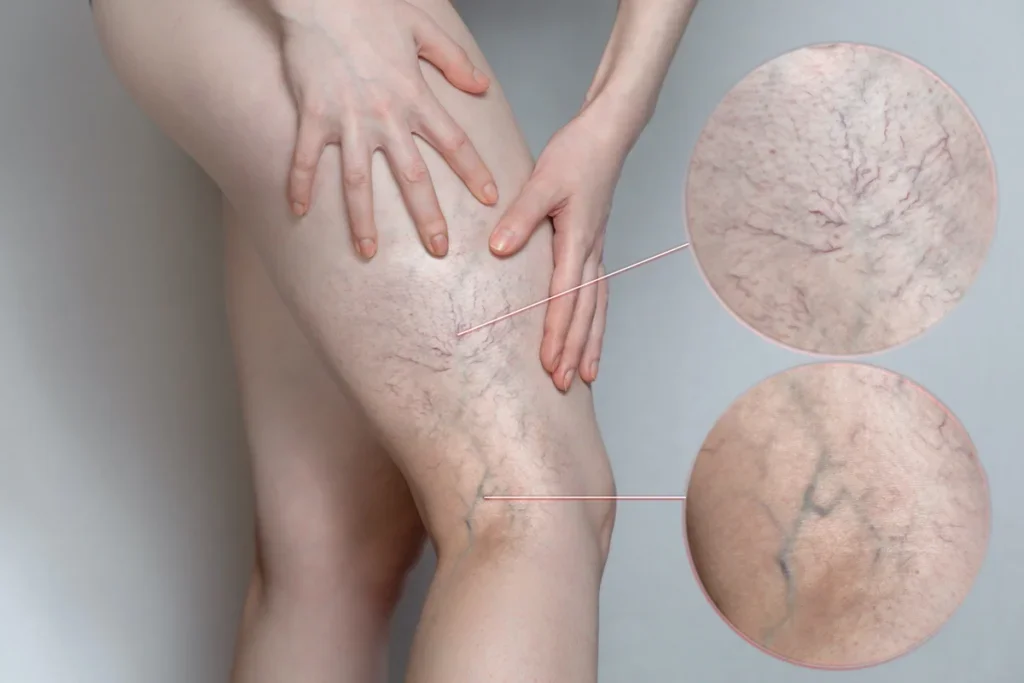
Medical illustration highlighting vascular conditions with zoomed-in circles showing fine thread veins and larger bulging veins
💡 What Is Laser Ablation?
Laser ablation uses a similar concept but relies on laser energy to close the affected vessel. A thin laser fiber is guided into the vein, and controlled energy heats the vessel wall. The vein then closes, allowing blood to travel through healthier pathways. Like radiofrequency treatment, laser ablation may be appropriate when testing identifies a refluxing vein that can be safely treated using this technique. The choice between the two depends on factors such as vein anatomy, ultrasound findings, and the provider's assessment.
💉 When Is Sclerotherapy Used?
Sclerotherapy takes a different approach. Rather than using a catheter and heat, a provider injects a sclerosing solution into a selected vein. The solution causes the targeted vessel to close, after which the body gradually processes it. This can be useful for certain smaller varicose or spider veins and selected surface vessels. Larger veins with significant reflux may require another approach, so an injectable treatment is not automatically suitable for every visible vein. Multiple sessions may sometimes be needed, depending on the number and size of vessels being treated.
🩻 Why Is Ultrasound-Guided Treatment Important?
A vein can look prominent on the surface while the source of the problem is located deeper underneath. That is why imaging can be an important part of treatment planning. With ultrasound-guided treatment, the provider can see the veins and blood flow in real time while identifying the vessels that may be contributing to the problem. Duplex ultrasound can also help detect reflux and provide information about the anatomy of the affected vessels. This information helps determine whether ablation, sclerotherapy, or another approach is appropriate. It also helps prevent treatment from being based solely on appearance.
🔎 What Does Non-Surgical Actually Mean?
Non surgical varicose vein treatment
Non surgical varicose vein treatment does not mean that you simply take medication or apply a cream and the veins disappear. It means the problem can potentially be treated without traditional open surgery.
For example, radiofrequency and laser procedures use a catheter or fiber inserted through a small opening in the skin, while sclerotherapy uses an injection. These are still medical procedures, but they generally involve less tissue disruption than conventional vein surgery. A non-surgical vein treatment may therefore provide an alternative to traditional vein stripping when the patient's condition is suitable.
🚶 What Is Recovery Like?
One of the reasons patients consider minimally invasive varicose vein treatment is that the process after treatment is generally less involved than recovery from traditional vein surgery. Many procedures are performed on an outpatient basis, allowing patients to leave after the treatment rather than staying in a hospital. Depending on the procedure, local numbing may be used, and patients are often encouraged to walk shortly afterward. Temporary soreness, bruising, tightness, or tenderness can occur around the treated area. Your provider will give you specific aftercare instructions and explain when you can return to your usual activities.
🏥 Is Outpatient Treatment an Option?
Many modern procedures are performed as outpatient vein treatment, meaning you can generally return home the same day rather than spending the night in a hospital. The experience varies depending on the procedure and your individual circumstances. Some treatments may take relatively little time, while others require additional preparation or follow-up. Your provider can explain what to expect before the procedure, including the type of anesthesia or local numbing that may be used, how long the appointment may take, and what activities you should avoid temporarily.
🎯 Can Varicose Veins Be Removed Without Surgery?
Varicose vein removal
People often use the phrase varicose vein removal to describe making unwanted veins disappear, but modern treatment does not always involve physically removing the vessel. With ablation, the targeted vein is closed so blood can reroute through healthier vessels. With sclerotherapy, selected smaller vessels are also closed and gradually become less visible. The goal is to address the problematic vessel and improve the underlying circulation, not necessarily to physically extract every visible vein. Results vary, and treated vessels may take time to fade. New visible veins can also develop in the future.
📍 How Do You Know Which Treatment Is Right?
There is no single procedure that works for every patient. A vein specialist will typically consider your symptoms, physical examination, vein anatomy, and ultrasound findings before recommending treatment. If reflux is present, the location and severity of the abnormal flow can help determine whether radiofrequency or laser treatment may be appropriate. Smaller surface vessels may be better suited to sclerotherapy, while some patients may not need a procedure at all. For patients considering care in Rancho Cucamonga, the most useful first step is an evaluation that identifies the source of the problem before deciding how it should be treated.
📍 Explore Your Options Without Traditional Surgery
If the thought of vein surgery has been keeping you from seeking care, it may be worth learning what modern treatment can offer. Several procedures can address problematic veins without the larger incisions associated with traditional surgery. The right approach depends on your individual anatomy and whether reflux or another underlying issue is present. A proper evaluation can help you understand whether a minimally invasive option is appropriate for your condition. Schedule an evaluation to learn which vein treatment approach may be right for you.
❓ Frequently Asked Questions
-
Many varicose veins can be treated using minimally invasive procedures such as radiofrequency or laser ablation. The appropriate option depends on the underlying vein problem.
-
Sclerotherapy can be appropriate for certain veins, particularly smaller varicose or spider veins. Larger refluxing veins may require a different treatment approach.
-
Treated veins can become less visible or close over time, but results vary depending on the vein and treatment used. New veins can also develop in the future.
